Printable Cat Body Language Cheat Sheet: Signals & Meows
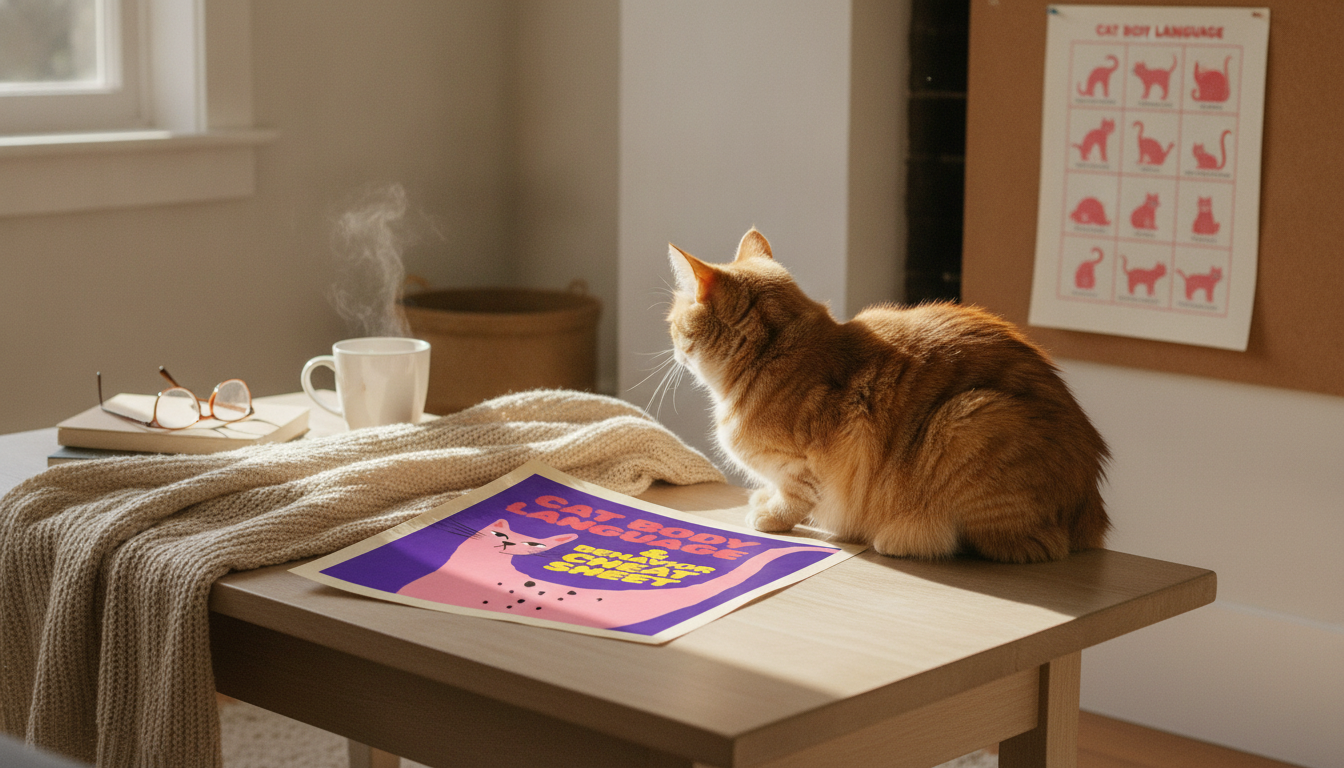
Cats communicate constantly—often without making a sound. Learning to read tail position, ear angle, eye shape, posture, and vocal patterns helps prevent bites and scratches, reduces stress, and strengthens trust. Use the sections below as a practical reference, then keep a printable cheat sheet handy for quick lookups in real moments.
How cats communicate: the full signal “package”
Cat body language works like a bundle deal: one signal rarely tells the whole story. A flicking tail plus forward ears can mean intense play focus, while the same tail motion paired with pinned ears and a stiff body can mean “stop now.”
- Look for clusters of signals (tail + ears + posture + context) rather than interpreting one body part in isolation.
- Consider distance: a cat that’s relaxed near you may show different signals than a relaxed cat across the room.
- Account for context changes (new guest, loud noise, vet carrier, playtime) that can flip meaning quickly.
- Note baseline personality and breed tendencies—some cats are naturally more vocal or more still.
For deeper behavior guidance and troubleshooting, reputable references include International Cat Care and the ASPCA cat behavior resources.
Tail positions and what they usually mean
The tail is one of the easiest “readouts” to spot from across the room. Use it as an early-warning system for overstimulation or as a green light for friendly greetings.
- Upright tail (often with a slight hook at the tip): friendly greeting and social confidence; often seen during approach.
- Puffed tail: high arousal (fear or excitement); pause interaction and give space to decompress.
- Tail tucked close to body: fear, uncertainty, or pain; reduce stimulation and offer safe hiding options.
- Tail swishing or thumping: agitation, overstimulation, or intense focus; stop petting if it escalates.
- Low tail carried loosely: cautious curiosity; allow the cat to choose distance and pace.
| Tail signal | Common meaning | Best response |
|---|---|---|
| Upright tail | Friendly/approachable | Greet calmly; offer a hand to sniff |
| Hooked tip | Happy/affiliative | Gentle talk; light petting if invited |
| Puffed tail | Startled/high arousal | Pause; increase distance; remove triggers |
| Fast swish/thump | Irritated/overstimulated | Stop petting; redirect to toy; give space |
| Tucked tail | Fear/pain | Quiet environment; let cat retreat; consider vet if persistent |
Ears, eyes, whiskers: the “facial dashboard”
If the tail tells you “what level,” the face often tells you “which direction.” Small changes—like ears rotating back or whiskers flattening—can happen seconds before a swat.
- Ears forward: interested and engaged; good moment for play or training.
- Ears sideways (“airplane ears”): uneasy or conflicted; reduce pressure and avoid looming over the cat.
- Ears pinned back: defensive or fearful; do not reach in—allow an exit route.
- Slow blink: relaxed, non-threatening communication; returning a slow blink can build trust.
- Dilated pupils: arousal (fear, excitement, pain, low light); check context and body posture.
- Whiskers forward: hunting/play interest; whiskers pulled back tight: stress or self-protection.
Posture and movement: relaxed, playful, defensive, or shut down
Posture is the “big picture” of comfort. When posture turns tight or low, assume the cat needs more control over distance and fewer surprises.
- Loose, curved body with weight distributed evenly: relaxed; interaction is usually welcome if the cat initiates.
- Side-lying or belly-up can mean trust, but is not always an invitation to touch the belly—watch paws, tail, and ears.
- Crouched low with tense muscles: ready to flee or defend; avoid cornering and reduce noise/handling.
- Arched back with sideways stance: defensive display; stop approach and create more distance.
- Freezing or sudden stillness: a warning sign; pause and reassess before continuing contact.
If shutdown behavior (hiding, flinching, sudden aggression, or new litter box issues) is new or escalating, consult a veterinarian and consider evidence-based behavior guidance such as the Cornell Feline Health Center.
Meows and sounds: matching vocalizations to needs
Vocalizations are flexible: the same cat may use different “meow styles” for different people. Pair the sound with what the body is doing (and what time of day it is).
- Short, soft meow: greeting or attention request; respond calmly without overstimulating.
- Repeated meowing: persistent need (food schedule, play, door access) or learned attention behavior; add routine and enrichment.
- Yowl/howl: distress, territorial tension, mating behavior (if not spayed/neutered), or pain; observe triggers and consult a vet if new.
- Growl/hiss/spit: “back off” signals; respect distance immediately and avoid punishment.
- Purring: often contentment, but can also appear during stress or pain; look at posture and breathing for confirmation.
- Chirp/chatter at windows: excitement/frustration at prey; offer interactive play to discharge energy.
Petting, play, and overstimulation: preventing scratches and bites
Many “out of nowhere” bites are really overstimulation that got missed. The goal is to stop while things are still good—before the tail thumps and the skin twitches.
Printable reference for everyday use
Recommended items (in stock)
- Cat Body Language & Behavior Cheat Sheet (Printable Cat Communication Guide)
- Dog Walking Waist Bag for Treats & Poop Bags
FAQ
Does a belly-up cat always want a belly rub?
No—belly-up often signals comfort or trust, but many cats will defend the belly if touched. Watch paws, tail, and ear position, and choose chin or cheek scratches unless the cat clearly invites belly contact.
Why is my cat purring but also acting tense?
Purring can happen during stress or pain as well as contentment. Check posture, hiding, appetite, grooming, and breathing, and seek veterinary guidance if the purring comes with new or worsening behavior changes.
What should be done when a cat hisses or growls?
Stop handling immediately, increase distance, and give the cat a clear escape route. Reduce triggers and reintroduce contact gradually using calm presence, treats, and play—never punishment.











Leave a comment