Memory Boost Worksheets: Printable & Digital Recall Drills
Memory Boost Worksheets: A Practical Way to Strengthen Recall
Remembering what you just read, heard, or studied isn’t only about “having a good memory.” It’s a trainable skill—especially when practice turns passive review into active work. Memory worksheets do exactly that by converting proven learning methods (like retrieval practice, chunking, and visualization) into quick, repeatable exercises that fit real schedules.
Whether the goal is exam prep, learning a new procedure at work, or simply recalling names and to-dos more reliably, the right pages make practice more focused and less time-consuming.
What Memory Worksheets Help With
- Turning passive review into active recall prompts that strengthen long-term memory
- Improving study efficiency by practicing retrieval instead of rereading
- Reducing forgetting between classes, meetings, and exams through spaced review
- Building attention and working-memory habits with short, focused drills
- Supporting everyday recall: names, lists, instructions, and routines
Research consistently shows that trying to pull information from memory (even imperfectly) builds stronger learning than simply studying again. A well-known example is retrieval practice outperforming elaborative study methods in controlled comparisons (Science). Worksheets make that “testing effect” easy to apply to any subject.
What’s Included in Memory Boost Worksheets (Printable + Digital)
The most useful memory practice pages aren’t random puzzles. They’re structured tools that map directly to what you’re learning—vocabulary, procedures, formulas, terms, speaking notes, or reading comprehension.
- Brain-training exercises that scale from beginner-friendly to more challenging sessions
- Memory technique pages: association, imagery, story chaining, and chunking prompts
- Study and recall tools: self-quizzing templates, summary-from-memory pages, and error logs
- Printable pages for distraction-free practice and digital pages for reuse and organization
- Options to match different goals: academic studying, professional learning, and daily-life recall
Worksheet Types and Best Uses
| Worksheet type | Best for | How to use in 5–10 minutes |
|---|---|---|
| Active recall prompts | Exam prep, learning new material | Close notes, answer prompts from memory, then check and correct |
| Spaced review planner | Long-term retention | Schedule quick reviews (same day, 2 days, 1 week) and track confidence |
| Chunking & grouping drills | Lists, definitions, sequences | Group items into 3–5 meaningful clusters and recite by group |
| Visualization & association pages | Names, concepts, vocabulary | Create a vivid image linking term + meaning; redraw or describe later |
| Error log & reflection | Fixing weak spots | Record misses, write the corrected answer, and plan next review |
A Simple Routine That Makes the Pages Work
Worksheets are most effective when they’re used as a loop: recall, check, correct, and revisit. A short routine keeps it consistent without turning it into another big task.
- Start with a baseline: pick one topic and time a 5-minute recall attempt without notes
- Practice retrieval first, review second: attempt answers before checking materials
- Use short spacing: revisit the same set after a few hours or the next day, not just once
- Interleave topics: mix two related subjects to improve discrimination and flexible recall
- Track progress with a confidence score (1–5) to decide what to repeat next
Spaced practice is a major lever for retention because it reactivates memory traces right as they begin to fade. A simple same-day/2-day/1-week pattern is often enough to notice improvement, especially when combined with brief self-tests (The Learning Scientists).
Printable vs Digital: Choosing the Right Format for Your Day
- Printable pages work well for deep focus, fewer tabs, and quick marking with pen or highlighter
- Digital pages suit repeat use, easy duplication, and organizing by subject or project
- Hybrid approach: print core drills for daily practice, keep planners and logs in digital form
- Make it frictionless: keep a small set of go-to pages that can be completed in under 10 minutes
If attention is the issue, printing a small “daily set” can reduce distractions. If organization is the issue, digital pages help keep separate folders for each class, certification, or work project—without constantly reprinting.
Who These Worksheets Fit Best
Memory and forgetting are normal parts of learning; what matters is building habits that counteract them. Even a few minutes of retrieval-based practice can reduce the “it felt familiar, so I thought I knew it” trap and make gaps visible sooner (see background concepts via the APA Dictionary topics on memory and forgetting).
How to Get Better Results (Without Spending More Time)
Memory Boost Worksheets for Students & Adults (Digital Download)
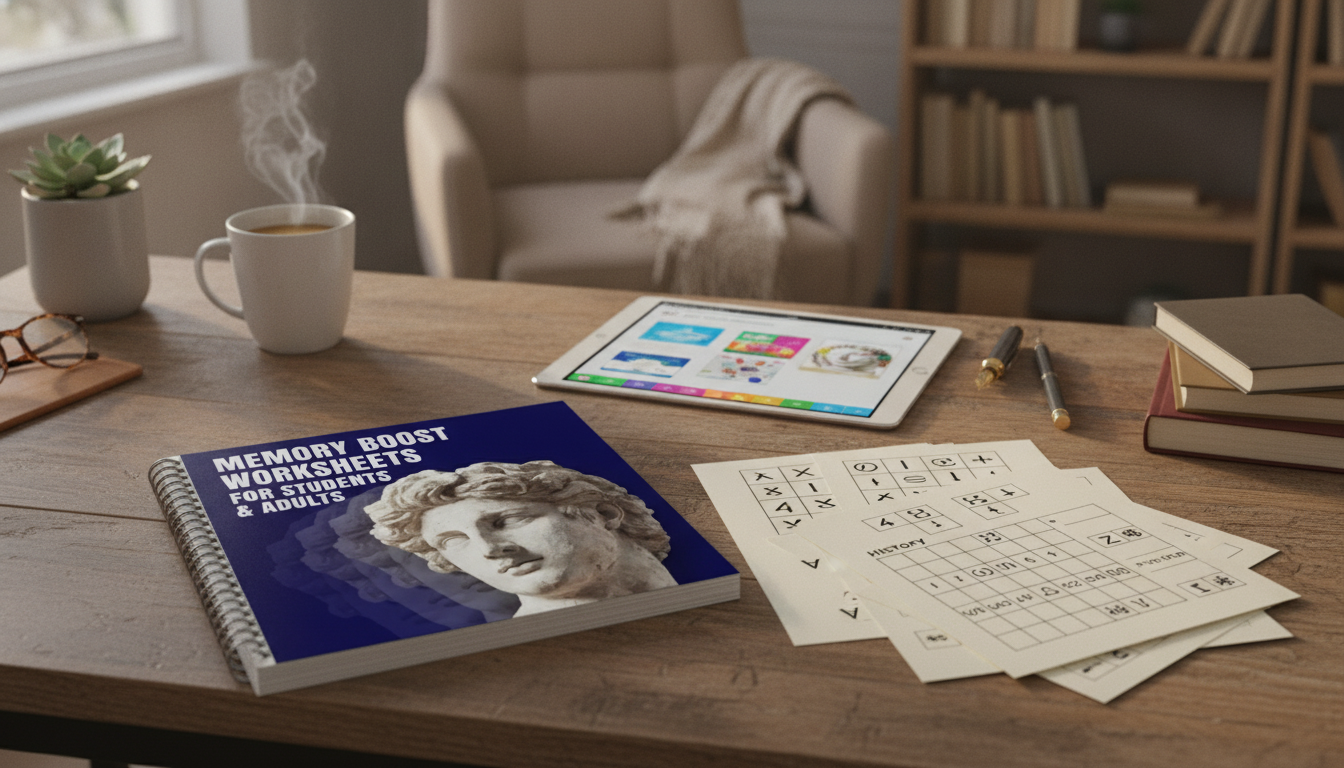
For a ready-to-use set designed to support real study and recall routines, explore Memory Boost Worksheets for Students & Adults (Printable Digital Download). The pack is built for structured practice with technique prompts, recall templates, and progress tracking—useful alongside textbooks, online courses, training modules, or independent learning plans.
To keep materials organized on the go, pair your study printouts and notebooks with a durable carry option like the Vintage Design Fashion Shoulder Messenger Bag, especially for commuting between classes, the library, and work.
FAQ
How often should memory worksheets be used to see improvement?
Use them 5–15 minutes per session, about 4–6 days per week. For best results, apply spaced review (same day, 2 days later, and again about 1 week later) and track confidence so time goes to the weakest items first.
Are memory worksheets helpful for adults, or only for students?
They help adults as much as students because retrieval practice strengthens whatever you’re trying to learn—work procedures, certifications, languages, or presentation notes. The pages can be filled with any topic, so the practice stays relevant instead of generic.
What’s the difference between brain-training games and worksheet-based practice?
Many brain-training games focus on general skills, while worksheets can target the exact information you need to remember. Worksheet-based practice ties recall to your real material (terms, steps, concepts), making improvements more likely to transfer to school, work, and daily tasks.










Leave a comment