4-Week Fit-at-Home Plan: Minimal Gear Workouts + Stretch
Fit at Home: A 4-Week Minimal-Equipment Workout Plan With Daily Workouts and Stretches
A structured month-long routine removes the guesswork from home training. This 4-week plan focuses on full-body strength, low-impact conditioning, and daily mobility using minimal space and simple equipment, with clear day-by-day sessions and stretches to support consistency. It’s built to be repeatable, adjustable, and realistic for busy schedules—without needing a full home gym.
What this 4-week plan is designed to do
- Build a repeatable weekly rhythm: strength days, conditioning days, and recovery-focused mobility.
- Improve movement quality with daily warm-ups and cooldown stretches.
- Support progressive overload without a gym by adjusting reps, tempo, rest, and leverage.
- Keep sessions time-efficient for busy schedules (typically 20–45 minutes depending on the day).
- Reduce decision fatigue with a ready-to-follow daily structure.
Over four weeks, the goal is steady improvement in strength, work capacity, and mobility—while keeping joints happy and technique consistent. For general activity benchmarks, the CDC’s overview is a helpful reference: CDC — Physical Activity Basics.
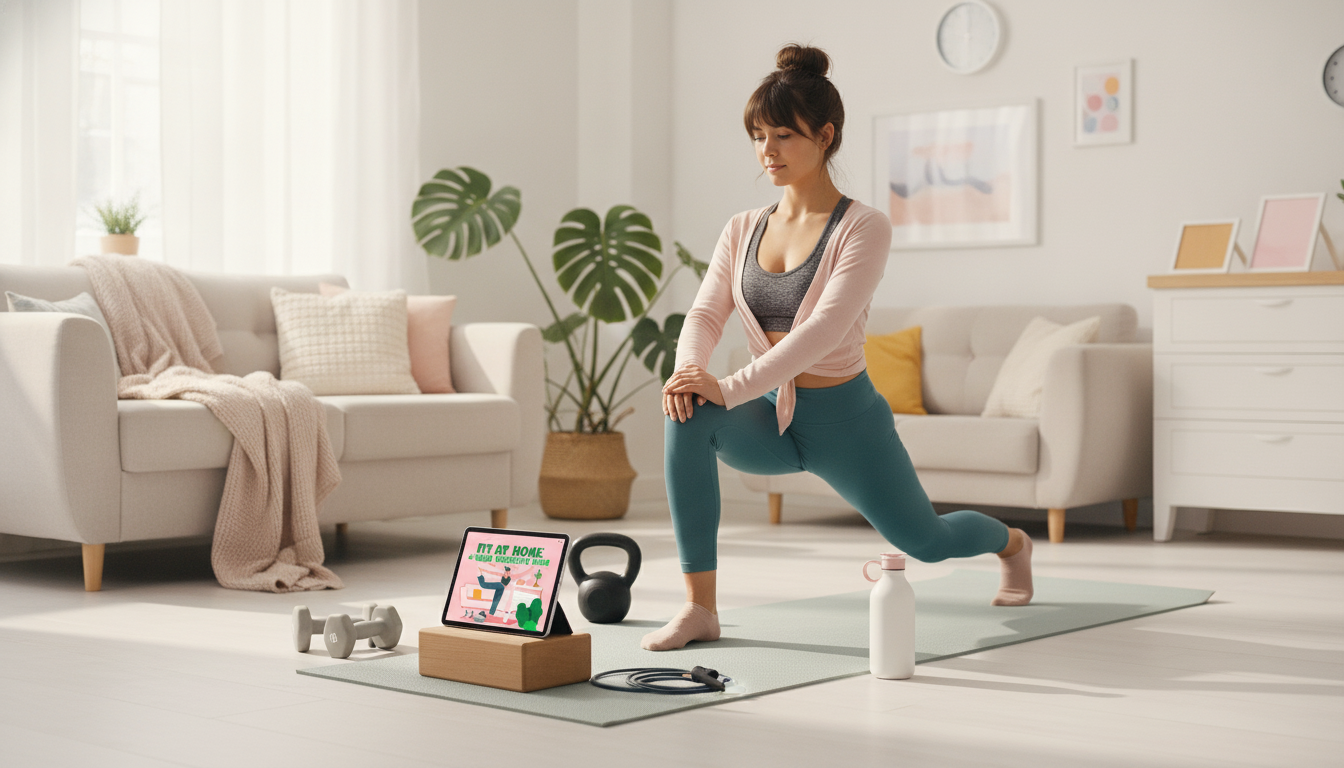
Minimal equipment and home setup
- Space: a clear floor area roughly the size of a yoga mat, plus a wall for support.
- Optional equipment: resistance bands, a pair of light-to-moderate dumbbells, a sturdy chair/bench, and a yoga mat.
- Household substitutes: a backpack for load, towels for sliders, water jugs for weights.
- Comfort and safety: supportive shoes for jumping/conditioning days, a non-slip surface, and hydration nearby.
If you’re using a backpack as a weight, make it stable (books wrapped in a towel work well) and keep the load close to your center of mass for squats, hinges, and step-ups.
How the week is structured (repeat for 4 weeks)
Each week repeats the same pattern so it becomes automatic: strength, mobility, conditioning, strength, mobility, conditioning, recovery. Strength days cover major movement patterns (squat/lunge, hinge, push, pull, carry/core). Conditioning days build aerobic capacity and work tolerance with intervals or steady work. Mobility/recovery sessions target common tight zones: hips, ankles, thoracic spine, shoulders, and hamstrings.
Progression is created by adding a set, increasing reps, slowing eccentric tempo, reducing rest, or increasing resistance. For strength training fundamentals, see ACSM — Resistance Training for Health and Fitness.
Sample weekly schedule (template used across the 4-week plan)
| Day | Focus | Session length | What to expect |
|---|---|---|---|
| Day 1 | Full-body strength A | 30–45 min | Lower-body + push + core; moderate rest |
| Day 2 | Mobility + light core | 20–30 min | Joint-friendly flow; breathing and posture work |
| Day 3 | Conditioning intervals | 20–35 min | Low-impact or mixed-impact intervals; scalable intensity |
| Day 4 | Full-body strength B | 30–45 min | Hinge + pull + unilateral work; controlled tempo |
| Day 5 | Mobility + steady cardio (optional) | 20–40 min | Walk, bike, or easy circuit + longer stretches |
| Day 6 | Conditioning + core finisher | 20–35 min | Shorter, higher effort; crisp technique emphasized |
| Day 7 | Recovery reset | 15–25 min | Gentle mobility, stretching, and rest-focused habits |
Daily session format (simple, repeatable, and scalable)
- Warm-up (5–8 min): marching or light cardio + dynamic mobility (hips, shoulders, ankles).
- Main work (12–30 min): 2–4 movements performed as straight sets or circuits.
- Core or accessory (3–8 min): anti-rotation, planks, glute activation, or posture work.
- Cooldown stretches (5–10 min): slower breathing + focused holds for tight areas.
- Intensity guide: finish sets with 1–3 reps left in reserve to keep form consistent.
That “reps in reserve” buffer is what makes day-to-day training sustainable at home—especially when sleep, stress, and work schedules fluctuate.
Progression across 4 weeks without overcomplicating it
- Week 1: Learn movements and choose starting levels; prioritize smooth reps and range of motion.
- Week 2: Add volume (extra set) or reps while keeping the same exercise variations.
- Week 3: Increase challenge via resistance or tempo (3-second lower on strength moves) and slightly shorter rest.
- Week 4: Consolidate and test consistency; aim for cleaner reps, better pacing, and improved recovery.
- Deload option: if sleep or soreness is high, reduce volume by 20–30% for 3–4 days.
When progress stalls, change only one variable at a time (more reps OR less rest OR slower tempo). Small, controlled changes add up quickly across four weeks.
Stretches that pair well with home workouts
If you want a simple library of flexibility drills to rotate in, this guide is a solid baseline: NHS — Stretching exercises.
Who this plan fits best
Recommended at-home training picks (in stock)
- Fit at Home: 4-Week Workout Plan | Minimal Equipment Exercise Guide PDF | Home Fitness eBook with Daily Workouts & Stretches — a day-by-day structure you can follow on a phone/tablet or print to keep workouts consistent.
- Vintage Design Fashion Shoulder Messenger Bag — a convenient grab-and-go option for carrying a water bottle, band, notebook, or tablet if you train between home, office, and outdoors.
Safety notes and smart modifications
FAQ
How long are the daily workouts in the 4-week plan?
Most sessions land around 20–45 minutes. Mobility and recovery days are usually closer to 15–30 minutes, while strength days run longer depending on rest periods and whether you add sets or resistance.
Can this be done with no equipment at all?
Yes—bodyweight variations can cover the entire plan. A chair can support squats and incline push-ups, a backpack can add load, and towels can work as sliders; progression comes from adding reps, slowing tempo, reducing rest, or using harder leverage.
How often should stretching be done with this routine?
Do a brief cooldown stretch daily and include longer mobility sessions about 2–4 times per week. Hold most stretches for 20–45 seconds, breathe slowly, and stop if you feel sharp pain.










Leave a comment